Jennifer Rubin just can't stand that Paul Ryan is being called out for the myriad lies in his speech last night: "But the 'lies' turn out not to be lies at all. They are not even misrepresentations or exaggerations." Don't you see? It's not just true. It's true-true. It's is. It is!
Glad we cleared up. Of course, a lot of people beg to differ. A lot. Including her employer.
Thursday, August 30, 2012


Friday, April 29, 2011
In Defense of Hating the Royal Wedding
Aside from the loop of Kate and William's vows playing on NPR this morning, I've been able to avoid most of the coverage of the royal wedding, and besides a few pithy grumblings from friends, I've also escaped the backlash. The response to the backlash, however, has been harder to avoid. The consensus isn't so much that I should care about the royal wedding as it is that I'm a jerk for finding it annoying.
Dave Weigel writes, "[V]eneration or celebrity-worship of some monarch who has no power over you seems mostly harmless."
It may be true that the wedding itself is just harmless pageantry, but as one friend aptly put it, "Both stories that dominated the news this week accept as entirely logical that power and title should depend on circumstances of your birth." Of course, the popular commentators have hardly ignored the British class system during the run-up to the nuptials. In fact, they've created a strong counter-narrative, claiming that Kate and William are ushering in a new era of "classless monarchy." As though there were such a thing. As though the phrase weren't so clearly an oxymoron.
The feminist critique of those decrying the wedding is harsher. Writes Amanda Hess:
The truth is that the royal wedding is this year's Superbowl of girl culture, the media has bended over backwards to cover the highly feminine event, and that tends to inspire a gut negative reaction in people. Why? Because feminine silliness is degraded in our culture, while masculine silliness is vaulted.
I can't say there's nothing to this. Regardless of my preference for the Superbowl, the beer, bacon, and body paint that accompany football games are certainly no less silly than cucumber sandwiches and funny hats. And yet, I think this is cheap shot. After all, the Superbowl says nothing about the system of class in this country or any other. The whole point of sports is arbitrary competition. The outcome of a game has no bearing on any contemporary cultural issue.
On the other hand, I did go see the last Roman Polanski movie, despite fully believing him to be a rapist who should be jailed. So is celebrating the royal wedding a tacit endorsement of classism? Perhaps not. But the subtext is worth bearing in mind.
Tuesday, November 09, 2010
Monday, November 01, 2010
Hipsterism and Childhood
Fiction Advocate responds to Mark Greif's New York piece with a post about hipsters and their obsession with childhood:
[The] observation – that much of what is “hip” in art today is overly concerned with the stuff of childhood – has been running through my posts on this blog for a while. There was the skepticism I showed for people like Neil Gaiman (Coraline) and Dave Eggers, again, with Spike Jonze (Where the While Things Are) who translate kids’ stories into big movies that are supposed to appeal to adults. . . . Lately it’s been hip for adults to make and consume art that’s essentially for children. I don’t know if the hipster is dead, as Greif says, but I hope this part of hipsterism is dead.
I'm working on a longer response to the Greif essay, but I think this illustrates why hipsters are so hard to define. There is certainly a strain of hipsterism that is concerned with parodying/glorifying things from childhood (think feathered headdresses), but the way in which various groups that we label "hipsters" have been concerned with childhood has changed substantially in the last decade. It's difficult to pinpoint a unified vision.
Meanwhile, within American culture in general, there is an obsession with youth that has grown in the last decade. Youth has been over-inflated for a long time, but the last ten years have seen its value balloon. We've seen the quarter-life crisis, the mainstreaming of twee, the rise of YA books for adults, and the casual office. The once stark line between adults and children has been blurred significantly. We can no longer rely on adults to dress and behave differently from children.
I don't have a larger point to make here, but the obsession with childhood isn't unique to hipsterism. If anything, it seems to be the dominant culture bleeding into subculture.
Monday, October 25, 2010
Monday Roundup
Glenn Greenwald has a good post about the failure of the NYT and WaPo's coverage of the latest Wikileaks story.
According to my friend Brian this book will soon be on sale.
If I understand correctly, this guy is suggesting that the economy sucks because Barney Frank had ACORN thugs force people to buy houses they couldn't afford.
My friend Ashley reviews The Descent.
The cover for Freedom 2 by Emperor Franzen has been revealed.

Friday, October 15, 2010
Friday, September 24, 2010
Friday Videos
Deerhunter, "Helicopter"
Crystal Castles, Celestica
The Hundred in the Hands, "Pigeons"
Crystal Castles, Celestica
The Hundred in the Hands, "Pigeons"
Friday, May 21, 2010
Hometown News: Where Else Can You Get This Sort of High Quality Racism?
To this day, I maintain an addiction to reading the letters in my hometown newspaper, which, considering that most letters are brimming with unadulterated idiocy, is a little surprising. Still there's something curious about how stupid ostensibly literate people can be.* Take for example this gleaming specimen of critical thinking by Mr. Ricky Tumlin, which starts off thus:
Can anyone please explain to me just exactly what is transpiring in this nation? It is beginning to appear like the years leading up to the rise of Nazi Germany in the early 1930s.
It is no longer fashionable to be patriotic.
Finally! After the better part of century of historical research, psychological and sociological theorizing, political science, and debate, someone has cracked the code: the Nazis just didn't love their country enough to stop killing Jews. What follows is a xenophobic screed against immigrants. The mind reels . . .
* I mean "literate" literally, meaning I'm assuming they didn't dictate their letters to someone else, but who knows?
Wednesday, May 19, 2010
What Makes a Great Jacket?
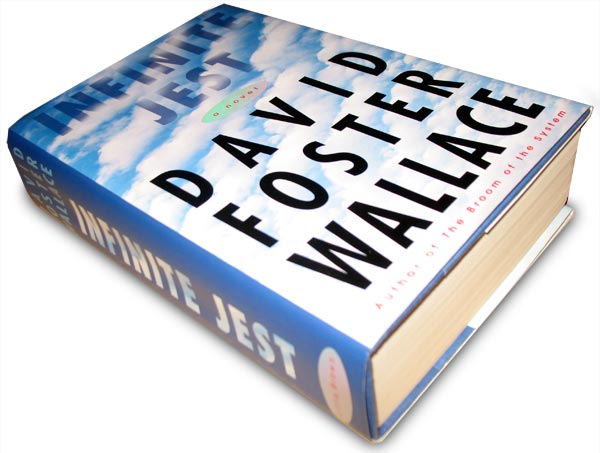
Via my friend/coworker/mentor Keith Hayes, who has three covers in AIGA's latest 50 Books/50 Covers, comes a post by Peter Mendelsund (one of my favorite non-Keith-Hayes designers) about the jacket for Infinite Jest. Mendelsund gives a great summation of what makes a good book cover:
Book jacket design should concern itself with, in my estimation, equal parts enticement ("Come buy this book") and exegesis ("This is what this book is about, more or less.") A good cover doesn't let one category trump the other. A good cover should not resort to cliché in order to accomplish either. But the real key here, in both categories (enticement and exegesis) is the designer's ability to work the sweet-spot between giving-away-the-farm, and deliberate obfuscation.
Book jackets that tell you too much, suck. Book jackets that try to change the subject also suck, and are furthermore, too easy.
Mendelsund goes on to explain why Wallace's suggestion (a design based around a photo of the making of Fritz Lang's Metropolis) would have been a huge mistake (too heavy-handed, too many cultural associations, not really what the book is about). On the other hand . . .
[. . .] a perfectly blue sky... A sky that only an advertiser could have dreamed up- a sky that could have been subsidized...A sky that stands in for satisfaction, but a satisfaction that is almost sinister in its perfection...(and, of course, HUGE type, because, well, that's just what's called for)...I think that was a very elegant solution. It tells you something very important, but leaves everything to the imagination.
What's curious about this cover in particular is that I've never quite thought about it. I judge covers all the time, but this one has always just had a sense of authority to it. I look at it and think, That is the cover for Infinite Jest, excluding in my mind the possibility of any other cover (though, in fact, there are three variations on the same theme in print). Which I suppose is a measure itself of the cover's greatness.
Monday, May 17, 2010
Thursday, May 13, 2010
Military Recruiters and Elena Kagan
Did Elena Kagan ban military recruiters from Harvard Law? According to Peter Beinart, not only did she ban them but she should apologize for what he calls an extreme expression of "national estrangement." Jill Filipovic takes him to task:
I’m not sure if Peter Beinhart is being intentionally intellectually dishonest in this column, or if he just doesn’t actually understand the issues involved in the decision of several law schools to ban military recruiters from campus. He takes Elena Kagan to task for her role, as Dean of Harvard Law School, in “banning” the legal branch of the U.S. military from coming and conducting on-campus interviews. In fact, Kagan didn’t actually ban the military at all — she accommodated them, just not through the Career Services office. And unlike other top law schools, which actually did block the JAG Corps from on-campus recruiting, Kagan allowed JAG recruiters to come to Harvard and interview students through the Harvard Law School Veterans Association, rather than through the career center.
Kagan didn't ban recruiters from the law school campus; she simply didn't allow them to recruit through the Career Services office, a move that Filipovic calls "an even-handed application of an existing policy that applies to all organizations and employers recruiting on campus." Still, they were allowed on campus through the Harvard Law School Veteran's Association.
Beinart argues that "[t]he United States military is not Procter and Gamble. It is not just another employer. It is the institution whose members risk their lives to protect the country." But as Filipovic points out, the recruiters weren't looking for soldiers. They were recruiting for the JAG Corps, which is "different than working in private practice, sure, but it’s not all that different from lawyering at a non-profit organization, or a firm, or as a law clerk, or in another branch of government."
Beinart is a smart commentator, but his hunger for history's narrative power and symbolism seems to lead him to false analogies. Just as Communism isn't a good analogue for Jihadism, Vietnam-era bans on the ROTC aren't good likenesses of Kagan's application of Harvard's anti-discrimination policies. It may make a good story—one that Republicans are eager to exploit—but that's no excuse for ignoring the details at the expense of honesty.
Monday, May 10, 2010
Is Publishing Cannibalizing Itself?
The current conventional wisdom on book publishing is that if the major houses can weather the rise of ebooks, the industry will be sound for foreseeable future, but this view ignores a lot of other pressing issues in publishing. Recently, former editor Jason Pinter wrote an article at HuffPo arguing that the maxim that men don't read has become a self-fulfilling prophecy. At Salon, Laura Miller followed up with an excellent analysis of the dwindling benefits—both tangible and social—of working in publishing and how editing has become "women's work."
Swelling of the Gland That Makes Stomach-Spit
Over at Bookslut, Jessa Crispin has an interesting discussion with writer and translator Katy Derbyshire about German words for the body, the difficulty of translating German sex scenes into English, and the German response to Charlotte Roche's Wetlands.
Wednesday, May 05, 2010
We're All Courtney Love Now
The will to blog is a complicated thing, somewhere between inspiration and compulsion. It can feel almost like a biological impulse. You see something, or an idea occurs to you, and you have to share it with the Internet as soon as possible. What I didn’t realize was that those ideas and that urgency — and the sense of self-importance that made me think anyone would be interested in hearing what went on in my head — could just disappear.
Because I haven't read much of anything on the Gawker network since Ana Marie Cox left for Time and stopped making dick jokes, I missed this now 2-year-old piece by blogger Emily Gould, whom I know mainly from her brief stint at GallyCat. The essay is confessional without being salacious, and it's interesting for how it discusses the relationship between one's personal life and writing. Writing can be away to escape a life of quiet desperation, or it can be an act of stepping over the line into loud, public desperation.
Thursday, April 22, 2010
Real vs. Authentic
The notion of authenticity is practically obsolete, and the idea of realness is just another categorical index, devoid of meaning. When real is gone, then there is no longer a litmus test for that which deviates from it. It's all real because it's all "real." We mined all the gold, and now we're mining the gilded.
The quote above reminded me of a long piece on authenticity that my friend Brian has been urging me to write for months now. Authenticity, it seems, has been wholly replaced by the "real." This is hardly a revelation, but regardless, the culture is still grappling with it. After all, what is "real"? Reality television presents edited and packaged versions of things that really happened, but when producers go about choosing stars who will act in the most salacious way possible, create situations that will assure stars' misbehavior, and then shape it into a narrative, in what sense is it more real and less constructed than fiction? Facts, it seems, are easy to take out of context and manipulate. But even if we grant that the cast members of Jersey Shore are real people doing real things, who in all seriousness could possibly call them authentic?
Archaic though it may sound, I feel strongly that something is lost when we substitute "realness" for "authenticity." Realness seems to have been created by marketers and producers for their financial gain, but is that true, or was it merely co-opted? And if so, authenticity was frequently co-opted too, right? Did realness just get snatched up faster? Part of the reason I've been less than eager to write a piece on authenticity is that I worry that I've failed to properly understand the meaning and value of realness or that I've inflated the meaning of authenticity, which has always been a complicated and often flimsy term.
Still, I wonder, what do teenagers today feel when they read Catcher in the Rye? Does the fact that we've so devalued the authenticity make Holden Caufield's cries against phoniness more urgent, or does it seem like a relic of some past generation that saw value to ideas that simply don't apply or speak to modern life?
Comments welcome.
Wednesday, April 07, 2010
Various
It is, according to my computer's Dashboard, 90 degrees outside. No one else seems to understand why this is great, but if I had my druthers, it would always be 90s degrees outside—at least when it's not raining.
In my office, we have one of those fancy Keurig machines that makes lots of different kinds of coffee, almost all of it awful. Today I was reminded of another office I worked in where we just had a couple large urns and could choose only between regular and decaf. That coffee was also awful, but there was a stronger sense of community in our shared hatred of it.
Georgia politics continue to be more interesting than New York politics.
It's not that I don't like a lot of the new surf-y garage rock that's coming out. It's just that I'd really, really love to hear something innovative and new.
I have a lot of unread books on my shelves, and with the exception of a few things that I like to keep to consult occasionally, I'm considering getting rid of them all and going back to the system I had in college and high school where I would buy a book and then read it right away.
Somehow I keep getting suckered into participating in a book club, even though I have no real interest in it. I'm currently trying to finish Rabbit, Run. Despite the occasional glimmers of lyricism, it's mostly tedious. The suburbs are boring. So, it turns out, is writing about the suburbs.
Thursday, March 18, 2010
If He Died in Memphis, Yeah, That's Be Cool
Alex Chilton died in New Orleans yesterday of a heart attack.
Friday, March 05, 2010
The Maddest Writer in the USA Has Died

On Monday, Barry Hannah, author of some of favorite short stories, died of a heart attack at his home in Oxford, Mississippi. Truman Capote famously called Hannah "the maddest writer in the USA." When I met him at the Oxford Conference for the Book, shortly after the publication of his brutally gorgeous novel Yonder Stands Your Orphan, he was stoic but generous. At Georgia State, I was an assistant to Pearl McHaney, who interviewed Hannah for Five Points and asked me to transcribe the tape. Inside my copy of High Lonesome, he wrote, "Thanks for the transcript." One of a convention's main speakers, he seemed embarrassed by the attention.
But in his earlier life, Hannah had been a heavy drinker. Stories of his personal life (such as, the time he launched a note at his ex wife's door with a crossbow) were almost as well-known as his writing.
Poet David Bottoms tells a story about Hannah. In the late '80s, when Hannah was paid to give a lecture on writing. I forget the school, but I want to say it was Vanderbilt. The scheduled time for the lecture comes and goes. Hannah is nowhere to be found. His handlers from the English department have lost all sense. They do their best to smooth over the situation and exhort the audience, mostly MFA students, to stay put. Mostly they do.
Hannah finally swaggers into the lecture hall 45 minutes late and trailing a cloud of whiskey perfume. He grabs the lectern to keep himself upright, and says, "Hi--sorry I'm late. I understand the theme of this lecture is 'How to Be a Writer.' The main things you need to be a writer are talent and something to say. After that, the first thing you need is a big dictionary." Hannah takes a step back, turns to the blackboard, and writes, "BIG DICTIONARY."
"It should cost at least $10," says Hannah and turns back to the board. He writes, "AT LEAST $10."
Hannah walks back to the lectern, straightens himself up, and says, "That's all I can tell you. Thanks for having me."
It seems Hannah actually had a good deal more to say about writing, which he taught at Ole Miss for two and a half decades.
I've often tried to push Barry Hannah's writing on my friends, and what I've found is that you either get Hannah or you don't. He often wrote crude things about tasteless, ignorant characters, but he made them real and wrote them with more feeling and energy than any other writer I know. In his story, "Love Too Long," one of Hannah's characters is so heartbroken over the loss of his marriage that he threatens God, saying that if there's not something like his wife in heaven, he will "appear in public places and embarrass the shit out of You screaming that I'm a Christian." All I can say is there better be something like Barry Hannah in heaven.
TRIBUTES
INTERVIEWS
UPDATE: Quote corrected.
Friday, January 22, 2010
Our Robot Masters Will Know How to Clean This Mess Up
The House Democrats seem hellbent on killing health care reform and dragging the entire party down with them, rather than sucking it up and passing the Senate bill. Sure, it's not perfect. Everyone admits that. Still, it's what we've got, and it beats losing for losing's sake. But, hey, don't take my word for it.
Josh Marshall: Pass the fucking Senate bill.
Paul Krugman: Pass the fucking Senate bill.
Steve Bennen: Pass the fucking Senate bill.
Kevin Drum: Pass the fucking Senate bill.
The "Experts" (TPM): Pass the fucking Senate bill.
Jon Cohn: Pass the fucking Senate bill.
Subscribe to:
Posts (Atom)