Deerhunter, "Helicopter"
Crystal Castles, Celestica
The Hundred in the Hands, "Pigeons"
Friday, September 24, 2010


Friday, May 21, 2010
Hometown News: Where Else Can You Get This Sort of High Quality Racism?
To this day, I maintain an addiction to reading the letters in my hometown newspaper, which, considering that most letters are brimming with unadulterated idiocy, is a little surprising. Still there's something curious about how stupid ostensibly literate people can be.* Take for example this gleaming specimen of critical thinking by Mr. Ricky Tumlin, which starts off thus:
Can anyone please explain to me just exactly what is transpiring in this nation? It is beginning to appear like the years leading up to the rise of Nazi Germany in the early 1930s.
It is no longer fashionable to be patriotic.
Finally! After the better part of century of historical research, psychological and sociological theorizing, political science, and debate, someone has cracked the code: the Nazis just didn't love their country enough to stop killing Jews. What follows is a xenophobic screed against immigrants. The mind reels . . .
* I mean "literate" literally, meaning I'm assuming they didn't dictate their letters to someone else, but who knows?
Wednesday, May 19, 2010
What Makes a Great Jacket?
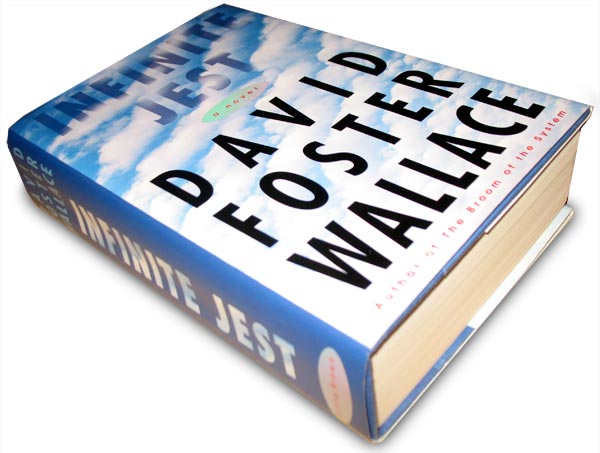
Via my friend/coworker/mentor Keith Hayes, who has three covers in AIGA's latest 50 Books/50 Covers, comes a post by Peter Mendelsund (one of my favorite non-Keith-Hayes designers) about the jacket for Infinite Jest. Mendelsund gives a great summation of what makes a good book cover:
Book jacket design should concern itself with, in my estimation, equal parts enticement ("Come buy this book") and exegesis ("This is what this book is about, more or less.") A good cover doesn't let one category trump the other. A good cover should not resort to cliché in order to accomplish either. But the real key here, in both categories (enticement and exegesis) is the designer's ability to work the sweet-spot between giving-away-the-farm, and deliberate obfuscation.
Book jackets that tell you too much, suck. Book jackets that try to change the subject also suck, and are furthermore, too easy.
Mendelsund goes on to explain why Wallace's suggestion (a design based around a photo of the making of Fritz Lang's Metropolis) would have been a huge mistake (too heavy-handed, too many cultural associations, not really what the book is about). On the other hand . . .
[. . .] a perfectly blue sky... A sky that only an advertiser could have dreamed up- a sky that could have been subsidized...A sky that stands in for satisfaction, but a satisfaction that is almost sinister in its perfection...(and, of course, HUGE type, because, well, that's just what's called for)...I think that was a very elegant solution. It tells you something very important, but leaves everything to the imagination.
What's curious about this cover in particular is that I've never quite thought about it. I judge covers all the time, but this one has always just had a sense of authority to it. I look at it and think, That is the cover for Infinite Jest, excluding in my mind the possibility of any other cover (though, in fact, there are three variations on the same theme in print). Which I suppose is a measure itself of the cover's greatness.
Monday, May 17, 2010
Thursday, May 13, 2010
Military Recruiters and Elena Kagan
Did Elena Kagan ban military recruiters from Harvard Law? According to Peter Beinart, not only did she ban them but she should apologize for what he calls an extreme expression of "national estrangement." Jill Filipovic takes him to task:
I’m not sure if Peter Beinhart is being intentionally intellectually dishonest in this column, or if he just doesn’t actually understand the issues involved in the decision of several law schools to ban military recruiters from campus. He takes Elena Kagan to task for her role, as Dean of Harvard Law School, in “banning” the legal branch of the U.S. military from coming and conducting on-campus interviews. In fact, Kagan didn’t actually ban the military at all — she accommodated them, just not through the Career Services office. And unlike other top law schools, which actually did block the JAG Corps from on-campus recruiting, Kagan allowed JAG recruiters to come to Harvard and interview students through the Harvard Law School Veterans Association, rather than through the career center.
Kagan didn't ban recruiters from the law school campus; she simply didn't allow them to recruit through the Career Services office, a move that Filipovic calls "an even-handed application of an existing policy that applies to all organizations and employers recruiting on campus." Still, they were allowed on campus through the Harvard Law School Veteran's Association.
Beinart argues that "[t]he United States military is not Procter and Gamble. It is not just another employer. It is the institution whose members risk their lives to protect the country." But as Filipovic points out, the recruiters weren't looking for soldiers. They were recruiting for the JAG Corps, which is "different than working in private practice, sure, but it’s not all that different from lawyering at a non-profit organization, or a firm, or as a law clerk, or in another branch of government."
Beinart is a smart commentator, but his hunger for history's narrative power and symbolism seems to lead him to false analogies. Just as Communism isn't a good analogue for Jihadism, Vietnam-era bans on the ROTC aren't good likenesses of Kagan's application of Harvard's anti-discrimination policies. It may make a good story—one that Republicans are eager to exploit—but that's no excuse for ignoring the details at the expense of honesty.
Monday, May 10, 2010
Is Publishing Cannibalizing Itself?
The current conventional wisdom on book publishing is that if the major houses can weather the rise of ebooks, the industry will be sound for foreseeable future, but this view ignores a lot of other pressing issues in publishing. Recently, former editor Jason Pinter wrote an article at HuffPo arguing that the maxim that men don't read has become a self-fulfilling prophecy. At Salon, Laura Miller followed up with an excellent analysis of the dwindling benefits—both tangible and social—of working in publishing and how editing has become "women's work."
Swelling of the Gland That Makes Stomach-Spit
Over at Bookslut, Jessa Crispin has an interesting discussion with writer and translator Katy Derbyshire about German words for the body, the difficulty of translating German sex scenes into English, and the German response to Charlotte Roche's Wetlands.
Wednesday, May 05, 2010
We're All Courtney Love Now
The will to blog is a complicated thing, somewhere between inspiration and compulsion. It can feel almost like a biological impulse. You see something, or an idea occurs to you, and you have to share it with the Internet as soon as possible. What I didn’t realize was that those ideas and that urgency — and the sense of self-importance that made me think anyone would be interested in hearing what went on in my head — could just disappear.
Because I haven't read much of anything on the Gawker network since Ana Marie Cox left for Time and stopped making dick jokes, I missed this now 2-year-old piece by blogger Emily Gould, whom I know mainly from her brief stint at GallyCat. The essay is confessional without being salacious, and it's interesting for how it discusses the relationship between one's personal life and writing. Writing can be away to escape a life of quiet desperation, or it can be an act of stepping over the line into loud, public desperation.
Thursday, April 22, 2010
Real vs. Authentic
The notion of authenticity is practically obsolete, and the idea of realness is just another categorical index, devoid of meaning. When real is gone, then there is no longer a litmus test for that which deviates from it. It's all real because it's all "real." We mined all the gold, and now we're mining the gilded.
The quote above reminded me of a long piece on authenticity that my friend Brian has been urging me to write for months now. Authenticity, it seems, has been wholly replaced by the "real." This is hardly a revelation, but regardless, the culture is still grappling with it. After all, what is "real"? Reality television presents edited and packaged versions of things that really happened, but when producers go about choosing stars who will act in the most salacious way possible, create situations that will assure stars' misbehavior, and then shape it into a narrative, in what sense is it more real and less constructed than fiction? Facts, it seems, are easy to take out of context and manipulate. But even if we grant that the cast members of Jersey Shore are real people doing real things, who in all seriousness could possibly call them authentic?
Archaic though it may sound, I feel strongly that something is lost when we substitute "realness" for "authenticity." Realness seems to have been created by marketers and producers for their financial gain, but is that true, or was it merely co-opted? And if so, authenticity was frequently co-opted too, right? Did realness just get snatched up faster? Part of the reason I've been less than eager to write a piece on authenticity is that I worry that I've failed to properly understand the meaning and value of realness or that I've inflated the meaning of authenticity, which has always been a complicated and often flimsy term.
Still, I wonder, what do teenagers today feel when they read Catcher in the Rye? Does the fact that we've so devalued the authenticity make Holden Caufield's cries against phoniness more urgent, or does it seem like a relic of some past generation that saw value to ideas that simply don't apply or speak to modern life?
Comments welcome.
Subscribe to:
Posts (Atom)