Tuesday, November 09, 2010


Monday, November 01, 2010
Hipsterism and Childhood
Fiction Advocate responds to Mark Greif's New York piece with a post about hipsters and their obsession with childhood:
[The] observation – that much of what is “hip” in art today is overly concerned with the stuff of childhood – has been running through my posts on this blog for a while. There was the skepticism I showed for people like Neil Gaiman (Coraline) and Dave Eggers, again, with Spike Jonze (Where the While Things Are) who translate kids’ stories into big movies that are supposed to appeal to adults. . . . Lately it’s been hip for adults to make and consume art that’s essentially for children. I don’t know if the hipster is dead, as Greif says, but I hope this part of hipsterism is dead.
I'm working on a longer response to the Greif essay, but I think this illustrates why hipsters are so hard to define. There is certainly a strain of hipsterism that is concerned with parodying/glorifying things from childhood (think feathered headdresses), but the way in which various groups that we label "hipsters" have been concerned with childhood has changed substantially in the last decade. It's difficult to pinpoint a unified vision.
Meanwhile, within American culture in general, there is an obsession with youth that has grown in the last decade. Youth has been over-inflated for a long time, but the last ten years have seen its value balloon. We've seen the quarter-life crisis, the mainstreaming of twee, the rise of YA books for adults, and the casual office. The once stark line between adults and children has been blurred significantly. We can no longer rely on adults to dress and behave differently from children.
I don't have a larger point to make here, but the obsession with childhood isn't unique to hipsterism. If anything, it seems to be the dominant culture bleeding into subculture.
Monday, October 25, 2010
Monday Roundup
Glenn Greenwald has a good post about the failure of the NYT and WaPo's coverage of the latest Wikileaks story.
According to my friend Brian this book will soon be on sale.
If I understand correctly, this guy is suggesting that the economy sucks because Barney Frank had ACORN thugs force people to buy houses they couldn't afford.
My friend Ashley reviews The Descent.
The cover for Freedom 2 by Emperor Franzen has been revealed.

Friday, October 15, 2010
Friday, September 24, 2010
Friday Videos
Crystal Castles, Celestica
The Hundred in the Hands, "Pigeons"
Friday, May 21, 2010
Hometown News: Where Else Can You Get This Sort of High Quality Racism?
To this day, I maintain an addiction to reading the letters in my hometown newspaper, which, considering that most letters are brimming with unadulterated idiocy, is a little surprising. Still there's something curious about how stupid ostensibly literate people can be.* Take for example this gleaming specimen of critical thinking by Mr. Ricky Tumlin, which starts off thus:
Can anyone please explain to me just exactly what is transpiring in this nation? It is beginning to appear like the years leading up to the rise of Nazi Germany in the early 1930s.
It is no longer fashionable to be patriotic.
Finally! After the better part of century of historical research, psychological and sociological theorizing, political science, and debate, someone has cracked the code: the Nazis just didn't love their country enough to stop killing Jews. What follows is a xenophobic screed against immigrants. The mind reels . . .
* I mean "literate" literally, meaning I'm assuming they didn't dictate their letters to someone else, but who knows?
Wednesday, May 19, 2010
What Makes a Great Jacket?
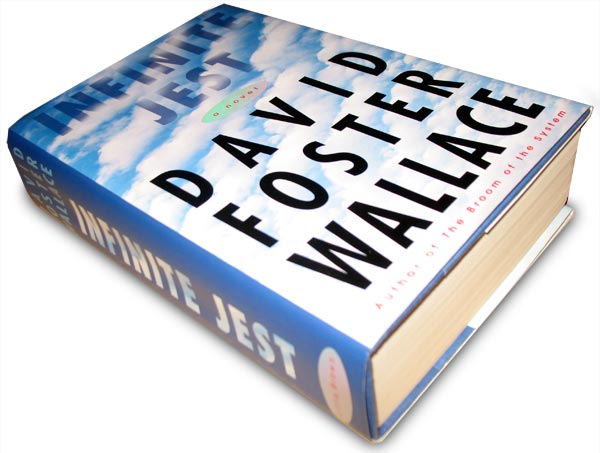
Via my friend/coworker/mentor Keith Hayes, who has three covers in AIGA's latest 50 Books/50 Covers, comes a post by Peter Mendelsund (one of my favorite non-Keith-Hayes designers) about the jacket for Infinite Jest. Mendelsund gives a great summation of what makes a good book cover:
Book jacket design should concern itself with, in my estimation, equal parts enticement ("Come buy this book") and exegesis ("This is what this book is about, more or less.") A good cover doesn't let one category trump the other. A good cover should not resort to cliché in order to accomplish either. But the real key here, in both categories (enticement and exegesis) is the designer's ability to work the sweet-spot between giving-away-the-farm, and deliberate obfuscation.
Book jackets that tell you too much, suck. Book jackets that try to change the subject also suck, and are furthermore, too easy.
Mendelsund goes on to explain why Wallace's suggestion (a design based around a photo of the making of Fritz Lang's Metropolis) would have been a huge mistake (too heavy-handed, too many cultural associations, not really what the book is about). On the other hand . . .
[. . .] a perfectly blue sky... A sky that only an advertiser could have dreamed up- a sky that could have been subsidized...A sky that stands in for satisfaction, but a satisfaction that is almost sinister in its perfection...(and, of course, HUGE type, because, well, that's just what's called for)...I think that was a very elegant solution. It tells you something very important, but leaves everything to the imagination.
What's curious about this cover in particular is that I've never quite thought about it. I judge covers all the time, but this one has always just had a sense of authority to it. I look at it and think, That is the cover for Infinite Jest, excluding in my mind the possibility of any other cover (though, in fact, there are three variations on the same theme in print). Which I suppose is a measure itself of the cover's greatness.
Monday, May 17, 2010
Thursday, May 13, 2010
Military Recruiters and Elena Kagan
Did Elena Kagan ban military recruiters from Harvard Law? According to Peter Beinart, not only did she ban them but she should apologize for what he calls an extreme expression of "national estrangement." Jill Filipovic takes him to task:
I’m not sure if Peter Beinhart is being intentionally intellectually dishonest in this column, or if he just doesn’t actually understand the issues involved in the decision of several law schools to ban military recruiters from campus. He takes Elena Kagan to task for her role, as Dean of Harvard Law School, in “banning” the legal branch of the U.S. military from coming and conducting on-campus interviews. In fact, Kagan didn’t actually ban the military at all — she accommodated them, just not through the Career Services office. And unlike other top law schools, which actually did block the JAG Corps from on-campus recruiting, Kagan allowed JAG recruiters to come to Harvard and interview students through the Harvard Law School Veterans Association, rather than through the career center.
Kagan didn't ban recruiters from the law school campus; she simply didn't allow them to recruit through the Career Services office, a move that Filipovic calls "an even-handed application of an existing policy that applies to all organizations and employers recruiting on campus." Still, they were allowed on campus through the Harvard Law School Veteran's Association.
Beinart argues that "[t]he United States military is not Procter and Gamble. It is not just another employer. It is the institution whose members risk their lives to protect the country." But as Filipovic points out, the recruiters weren't looking for soldiers. They were recruiting for the JAG Corps, which is "different than working in private practice, sure, but it’s not all that different from lawyering at a non-profit organization, or a firm, or as a law clerk, or in another branch of government."
Beinart is a smart commentator, but his hunger for history's narrative power and symbolism seems to lead him to false analogies. Just as Communism isn't a good analogue for Jihadism, Vietnam-era bans on the ROTC aren't good likenesses of Kagan's application of Harvard's anti-discrimination policies. It may make a good story—one that Republicans are eager to exploit—but that's no excuse for ignoring the details at the expense of honesty.